

Bachelor of Science in Finance

Finance


Study Finance at the Center of Business and Policy
The AACSB-accredited Finance program at GW Business combines rigorous coursework with real-world experiences that bring finance to life. Build a strong foundation in financial analysis, investments and corporate finance while exploring how financial decisions shape businesses, markets and economies. Then put what you learn into practice through hands-on experiences, student organizations and connections to Washington, D.C.’s dynamic financial ecosystem.

Washington, D.C. Is Your Finance Classroom
At GW, you’ll be steps away from federal agencies, major financial institutions and businesses shaping markets and economic policy. From the Federal Reserve, World Bank and International Monetary Fund to regulators and global organizations, GW Business puts the people and institutions making finance policies and regulations within reach.
That proximity creates opportunities to learn from industry leaders, attend high-profile events, build professional connections and gain experience beyond the classroom through internships and networking.
Program Opportunities
The Finance program offers multiple pathways for GW students interested in pursuing a career in the finance industry, including commercial banking, investment banking, asset management, consulting, government or insurance.
- Earn a Bachelor of Science in Finance
- 120 total credits, including 30 credits in finance major coursework
- Earn a Bachelor of Science (BS) in with a Major in Finance
- Includes 5 business core courses (15 credits), 10 interdisciplinary major courses (30 credits), and 40 credits in elective courses that provide the opportunity for students to pursue concentration(s), minor(s), or an additional major.
- Available to GW Business School students
- Declare a Second Major in Finance
- 10 courses | 30 credits
- Available to all GW students pursuing another primary major
- Minor in Finance or Real Estate
- 6 courses | 18 credits
- Open to non-GW Business School students
- Add a Finance or Real Estate Concentration
- 5 courses | 15 credits
- Available to GW School of Business students
- Dual Degree: Bachelor's + Master's
The 4+1 Program: Earn Your Bachelor’s and Master’s in Five Years
In a competitive business environment, having a master’s degree can lead to higher-level positions, more responsibility and greater earning potential. The 4+1 Program is a dual degree program that offers undergraduate students the opportunity to earn an accelerated master’s degree from the GW School of Business.

What You’ll Learn
Your coursework will explore finance from three interconnected perspectives:
- Financial management: Capital budgeting, financial structure and analysis, working capital management and dividend policy
- Investment and portfolio management: Valuation of stocks, bonds and derivative contracts and the construction of efficient portfolios
- Money and capital markets: The issuance and investment in financial instruments, with an emphasis on how interest rates and interest rate structures affect valuation and risk
You’ll build on this foundation through coursework in areas such as corporate finance, financial derivatives, financial technology, quantitative investing, venture capital and real estate, as well as numerous special topic classes such as AI in Finance, Sustainable Finance, Crypto Finance and Climate Finance.
Meet the GW Finance Community
What’s it like to study finance at GW? Hear from current students and faculty about the classroom experience and the unique #OnlyatGW opportunities that can shape your future in finance.
Student Spotlight

Cole Hadar, Bachelor of Finance ‘26
Cole fostered an early interest in finance. His grandfather introduced him to investing as a child, walking him through account statements and explaining dividends when Cole was just six years old. That curiosity grew through finance internships in high school and watching his brother build a career in the field. By the time he arrived at GW, pursuing a degree in finance felt like a natural fit.
- Read More
In the classroom, Cole highlights professors who bring real-world experience to their teaching. Alex Caffrey, Adjunct Professor of Finance, who worked in banking and now runs a real estate and private equity firm, taught Excel with Financial Modeling, where Cole built a Discounted Cash Flow valuation for Tesla stock. Robert Savickas, Associate Professor of Finance, stood out as an Advanced Financial Management professor who always engaged his students in classroom discussions and debates, requiring students to find evidence in their analysis and defend their positions against classmates. Alexandre Baptiste, Associate Professor of Finance, and Senay Agca, Professor of Finance, have also been incredible resources to him.
One of the aspects of GW that surprised Cole was the structure built into the early business curriculum. Through the Business Leader Development (BLD) program, students are guided to create LinkedIn profiles, build a resume, conduct coffee chats and meet upperclassmen. It was through a BLD mentor that Cole first learned about Wall Street Finance Alliance (WSFA), which became an important part of his experience and equipped him with the necessary skills for a career in investment banking. He has since become one of the senior leads in WSFA, where he helps run meetings, guides younger members to develop technical proficiency and in recruiting preparation, and serves as a mentor to underclassmen navigating the same career path. Cole interned at Jefferies in the Automotive Aftermarket Group during his junior summer and will be looking to return full-time as an investment banking analyst. In the program, important takeaways include:
- Think critically about financial data and challenge assumptions to come to original conclusions and findings.
- Navigating the professional landscape early by building habits around networking, outreach, and personal branding.
- Translating financial theory into practical application through hands-on modeling and valuation exercises.
The connections Cole has made extend well beyond professional life. He has built rewarding, lifelong friendships with peers he met through classes, club involvement, and recruiting. For anyone considering the program, Cole’s advice is to simply involve yourself. Attend club meetings, go to office hours, integrate yourself in your classes, and see what sticks. The students who take away the most at GW are the ones who show up. Looking ahead, Cole is focused on passing his series exams, learning as much as he can, and building a strong start to his career.
#OnlyAtGW Experiences
GW Business and the broader university community offer a robust ecosystem of centers, initiatives and student organizations that support the Finance program, giving you opportunities to apply classroom learning to real-world strategy, policy and consulting challenges.

Learn From Experts in the Field
Learn from professors whose research is actively informing policy and shaping how we understand financial markets, investors and financial institutions. Their work appears in leading finance journals and examines real-world questions about everything from bond markets and credit risk to AI and emerging financial technologies. Their research brings current insights into the classroom, giving students the opportunity to engage with current issues and ideas shaping the field.
A Finance Community on the Go
Take your finance education beyond the classroom through experiences that put your skills to work. Explore investments through student-managed funds, tackle real-world challenges through applied projects and finance and entrepreneurial competitions, gain professional experience through internships, and get involved with finance-focused student organizations. You’ll also find unmatched opportunities to connect with alumni and industry professionals, including an annual networking trip to New York, and study abroad experiences. Together, these experiences help you build your skills, expand your network and explore where your interests can take your career.

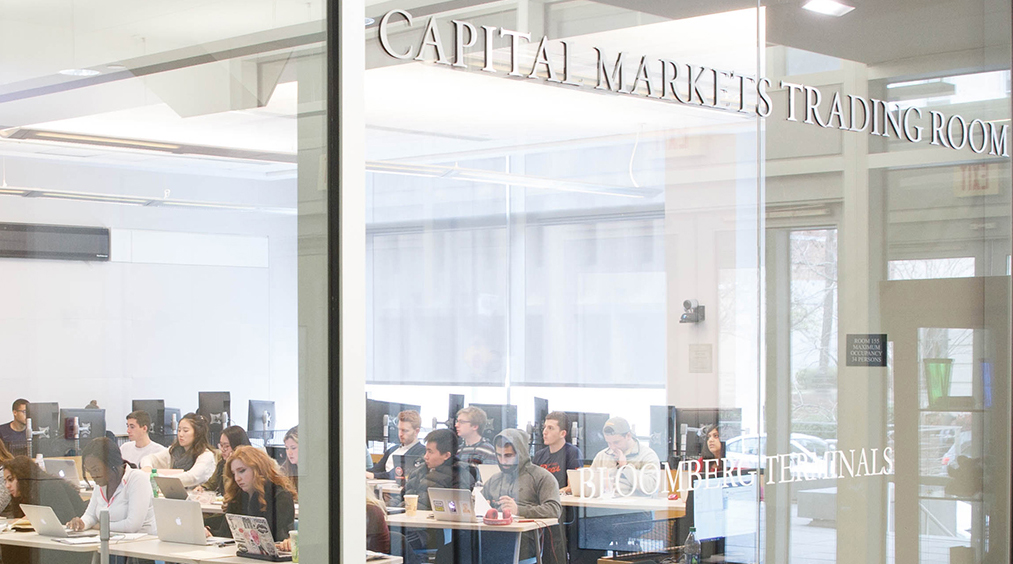
Manage Real-World Investments
Through the GW Investment Institute, students gain hands-on experience in investment analysis and portfolio management. Working as analysts and portfolio managers, students manage more than $12 million in university endowment funds, putting their classroom knowledge to work in the Capital Markets Trading Room. The space simulates the high-stakes atmosphere of Wall Street, complete with Bloomberg Terminals providing real-time market data.
- Investment Institute Courses
- FINA 4101: Applied Financial Securities Analysis: Learn practical security analysis techniques and investment approaches used by professional investment managers.
- FINA 4102: Investing in Real Estate Investment Trusts: Explore security analysis and investment approaches through the management of the GW Real Estate Student Investment Fund.
- FINA 4103: Quantitative Investing: Analyze time-series data and collaborate with classmates to build and test predictive models using real data.
- FINA 4104: Foundations of Venture Capital: Study the practical aspects of venture capital investing, with relevance to careers in venture capital, venture-backed startups, corporate innovation and related financial services.
Get Steps Ahead on Your Career Search
The Wall Street Finance Alliance and Finance 360 programs give first- and second-year students personalized mentorship and career support to help them get a head start in the finance industry.
Through the programs, students gain:
- Industry insight: Learn from finance professionals working in Wall Street careers.
- Career guidance: Get support with resume development, job search strategies and interview preparation.
- Alumni mentorship: Build relationships with accomplished GW alumni and gain access to their professional networks, including potential internship and career opportunities.
Career Pathways
A finance degree can open doors across industries and sectors, from global corporations and financial institutions to government agencies and entrepreneurial ventures. Build the skills and business foundation to pursue a wide range of careers, while also preparing for advanced study in business, economics, public policy or law.
Career areas include:
- Investment Banking
- Commercial Banking
- Asset Management
- Financial Analysis
- Consulting
- Insurance
- Government & Public Policy
- Real Estate
Recent graduates have gone on to careers with organizations including:
- Barclays
- Bloomberg
- Citigroup
- Deutsche Bank
- Goldman Sachs
- J.P. Morgan
- Morgan Stanley
- Perella Weinberg Partners
- TD Securities
- Vista Equity Partners
- Wells Fargo
Career Support
Personalized Career Coaching
Experienced career coaches with a proven track record of supporting successful career outcomes and advancement help you build an effective job search strategy while providing resume reviews and mock interviews.
Dedicated Career Center
The GW Business F. David Fowler Career Center provides exclusive access to employer connections, recruiting opportunities and career resources, including professional development workshops on technical skills, presentations and salary negotiation.
Mentorship Opportunities
Participate in the Careers360 program to connect with industry mentors in consulting, finance or marketing.
Global Alumni Network
With more than 60,000 alumni spanning 260+ organizations, Fortune 500 companies, startups, and nonprofits around the world, you’ll gain access to mentorship, connections, and career opportunities that open doors and accelerate your impact.

Next Steps
In Washington, D.C., opportunity is everywhere. See it for yourself. Request information, visit the GW campus, talk with our admissions team, or take the first step by applying today.
Current GW Student? Transfer to GW Business or declare a Finance major/minor/concentration.
Latest News & Research from GW Business

Q & A: Financial Investing for Beginners
September 21, 2026

What Can You Do With an MS in Applied Finance?
August 4, 2026

